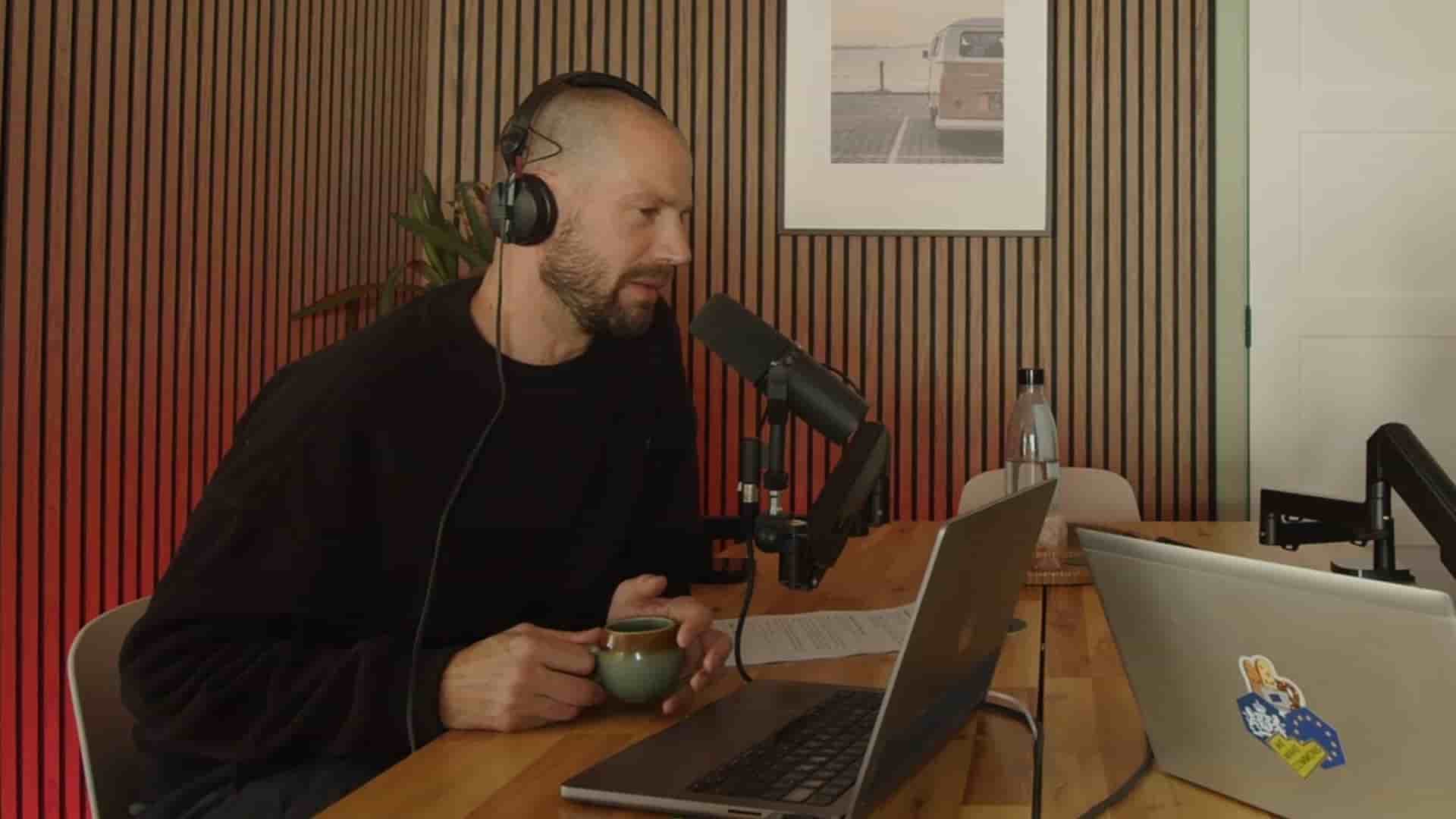
Frank and Jakko launch their tech podcast exploring AI security threats, digital autonomy, and whether robots will replace carpenters.
The decision happened the way these things often do. Two friends talking about technology, society, and the rapid changes reshaping our world. Eventually someone says it: we should start a podcast. And then, somehow, you actually do it.
Frank and Jakko found themselves in the old rectory of the Sindianese church in Breukelen, a space normally used for creative sessions, now serving as the birthplace of their new podcast. The setup might be humble, but the ambition is clear. They want to explore the intersection of technology, science, society, and humanity with the kind of genuine curiosity that cuts through the noise.
"I'm basically a terrible nerd," Frank admits. "I love technology, but technology doesn't exist in a vacuum. There needs to be policy around it, and people need to guide the technology." He works in product and testing at a tech startup building a podcast app for creators, and moonlights as a techno DJ. But in this capacity, he's simply the tech explainer nerd who wants to understand everything.
Jakko brings a different perspective, working in the public domain on socially responsible digitalization for Dutch municipalities and in a European context. "I have a super broad interest in everything related to technology, science, society, people," he explains. "I'm mainly very curious about who we can get behind the microphone who has interesting things to tell."
The conversation quickly turned to what's been keeping them awake lately, and they landed on the same topic without even coordinating: AI security capabilities, specifically Anthropic's development of a model so powerful that the company decided not to release it publicly.
"Imagine an AI model that in one night finds 211 security vulnerabilities in Firefox. Vulnerabilities that were undiscovered. Firefox cooperated with it. But that model is so powerful that Anthropic, the company behind the model, decided not to make it public."
The implications are staggering. What happens when this kind of capability falls into the wrong hands? It's a genuine concern for critical infrastructure. While we can all write code, someone with real skills using a model like this creates a serious problem.
Frank draws a comparison that's hard to ignore: "It sounds a bit like someone who developed an atomic bomb and then puts it in the hands of people who actually can't handle it at all." The question that haunts him is whether humanity is wise enough to deal with this kind of intelligence. His fear is that we're certainly not all equipped for it, and most of us aren't sufficiently prepared.
Are we as humanity wise enough to deal with this kind of intelligence? I fear the answer is that we're certainly not all equipped for it.
Then came the kicker: the model was supposed to be kept under wraps, but it turned out a group of users could access it via Discord. Not even through a hack, just by knowing where to look.
While AI security threats dominated one thread of conversation, Frank introduced another concern that hit closer to home, literally. At a major robotics fair in Shenzhen, China, the future of physical labor is on full display. And it's making him rethink career advice.
His eldest son recently did an internship at a company, and the designers there told him bluntly: don't do it, your job won't exist in 10 years. The teenager completely changed direction, now pursuing woodworking and furniture making at a technical college. Frank's response? "Good choice, man. Something with your hands, then you'll have something later. You've learned a trade."
But then the two concerns collided. Looking at the robotics fair and his son's career choice, Frank had an unsettling realization: "Can it be that soon you'll just hire a digital contractor?" He's not joking. If robots at the fair can screw caps on bottles now, then in 10 to 15 years, with the AI injection we're seeing, a van could pull up with humanoid robots that build your house.
In 10 to 15 years, a van could pull up with humanoid robots that build your house.
He points to Terraform, a company in their shared workspace building masonry robots. Walking past these machines daily, Frank watched them get faster and better at laying bricks. You simply upload a design of your house, and the robot works 24/7. "This is really old news," he notes. "But it's bizarre that it's possible." When you look at the curves of these technologies and extrapolate the timeline, we really might have digital contractors.
The business model is telling too. The Terraform founder isn't selling robots, he's renting the service. Large construction companies can sign contracts. "This is just where we're going," Frank observes. It's the same model Elon Musk uses with Tesla's humanoid robot Optimus, which can walk. You rent it, and if you want it to bake, you download a software upgrade.
To dig deeper into the AI security implications, they called Jesse Seegers, a former member of the Dutch parliament for Nieuw Sociaal Contract, with a background at the AIVD (Dutch intelligence service). Now working at Digital Duet, Jesse brings both policy experience and intelligence tradecraft to understanding these emerging threats.
When asked about Anthropic's Mittels model and Project Glasswing, which has granted access to companies like Amazon, Apple, and Google, as well as defense organizations, Jesse offered measured perspective. "I find it plausible that AI systems will at some point become better than nation-state actors when it comes to hacking capabilities," he explained. "Whether Mittels already has that, I can't assess."
"The question is how scalable that is and whether the vulnerabilities it found here are also extrapolatable to other vulnerabilities. That's ultimately largely a statistical problem, and AI is very good at that."
What fascinates Jesse is the power distribution this creates. By not making the model freely available but only releasing it to select partners, mainly large American companies, you create a reinforcing effect. "Those who are already strong become stronger," he notes. The most advanced players in cybersecurity gain access to the most advanced AI models, widening the gap.
The attacker-defender dynamic gets complicated quickly. If AI models can be used for "purple teaming" (combining red team attacks and blue team defense), and it becomes standard to release updates with this approach, some companies could gain enormous advantages. But attackers also gain an advantage because they can simultaneously probe all possible vulnerabilities, and not all companies have the capabilities to patch in time.
Jesse's concern extends to digital autonomy. "It could become much more difficult for Dutch players to offer the same level of security as the large players can," he warns. The new forces at play could fundamentally reshape the landscape, though he's careful to add that there's much we simply don't know yet.
One lesson emerging from these developments is stark: the Netherlands has a serious problem with how long it takes to patch vulnerabilities and resolve cyber incidents. "That time, we simply don't have anymore," Jesse observes. While the situation isn't always dramatic, there's now a very clear need for a fast lane.
The evidence is visible almost daily. Just recently, the municipality of Epen lost a significant amount of personal data to theft. It's one of countless hacks making the news, making it painfully clear that AI tooling is being deployed against things that can't withstand daylight. "So it's crucial that you know how to arm yourself against this," Jesse emphasizes. "We simply have no choice."
When asked what he can do now at Digital Duet that he couldn't in parliament, Jesse points to execution. In politics, you have significant power through motions and legislation to steer and enforce things. But there's a gap between talking about digital autonomy and actually doing something about it. "The step from 'we need to do something about this' to 'we're actually going to do it,' we can now bridge that as Digital Duet," he explains. It's about moving beyond the discussion clubs and reports to actually implementing the necessary tools.
As the first episode wound down, Frank and Jakko sketched out their vision. They want to serve as a public filter, bringing interesting topics and knowledgeable guests to listeners. Frank is eager to have someone explain quantum technology in simple terms. Jakko mentioned that Jesse had done work on quantum, so connections are already forming.
Other interests emerged: the TU Delft teams working on solar challenges, engineering at the highest level performed by students. The beauty of their framework, covering technology and science at the intersection of society and humanity, is that it opens virtually everything up for conversation. But the focus remains clear: find people who know a lot about specific subjects and give them a platform.
"I love that variety," Jakko notes. "I know a little bit about everything, and that's why I'm super interested in people who know a lot about one subject."
Throughout the conversation, a running joke emerged. When you turn 40, you either buy a motorcycle or start a podcast. Frank and Jakko chose the latter, though Jesse, still in his thirties, joked that he might already have 10 podcasts before he hits that milestone.
The informal setting matters to them. There's already so much talk with high professional production values and perfect studio setups. They wanted something that felt more like a conversation you'd have at a pub, just with better audio. "It's mainly on a personal basis," Jakko emphasizes.
The working title? "What's on the Table" (Wat Verder Ter Tafel Komt), though Frank's facial expression suggested he wasn't entirely sold yet. But as they noted, OpenAI changed its name eight times in three months, so flexibility is built into the process.
Their philosophy is refreshingly simple: if we find it interesting, maybe other people will too. And if it stops being fun, they'll stop doing it. But as long as they enjoy it, that's already a win.
What makes this podcast potentially valuable isn't just the topics they'll cover, but the perspective they bring. Frank's technical depth combined with Jakko's public sector experience creates a unique vantage point. They're not trying to be the most polished or professional podcast out there. They're two genuinely curious people trying to understand the rapid changes reshaping our world.
In an era where AI can find hundreds of security vulnerabilities overnight, where robots are learning to build houses, and where the line between science fiction and reality blurs daily, having accessible conversations about these developments matters. Not everyone needs to become an expert in cybersecurity or robotics, but everyone will be affected by these changes.
The question they keep circling back to is the one Frank posed about humanity's collective maturity. If we're at the level of a preschool class in terms of how we handle powerful technologies, should we be equipping ourselves with atomic bombs? It's a provocative comparison, but it captures the stakes.
As they wrapped up their first recording in that church rectory in Breukelen, the experiment was officially underway. Two friends, a bunch of questions, and a willingness to learn in public. Whether it becomes episode one or just a pilot, they'd taken the first step. The rest, as they say, remains to be built.