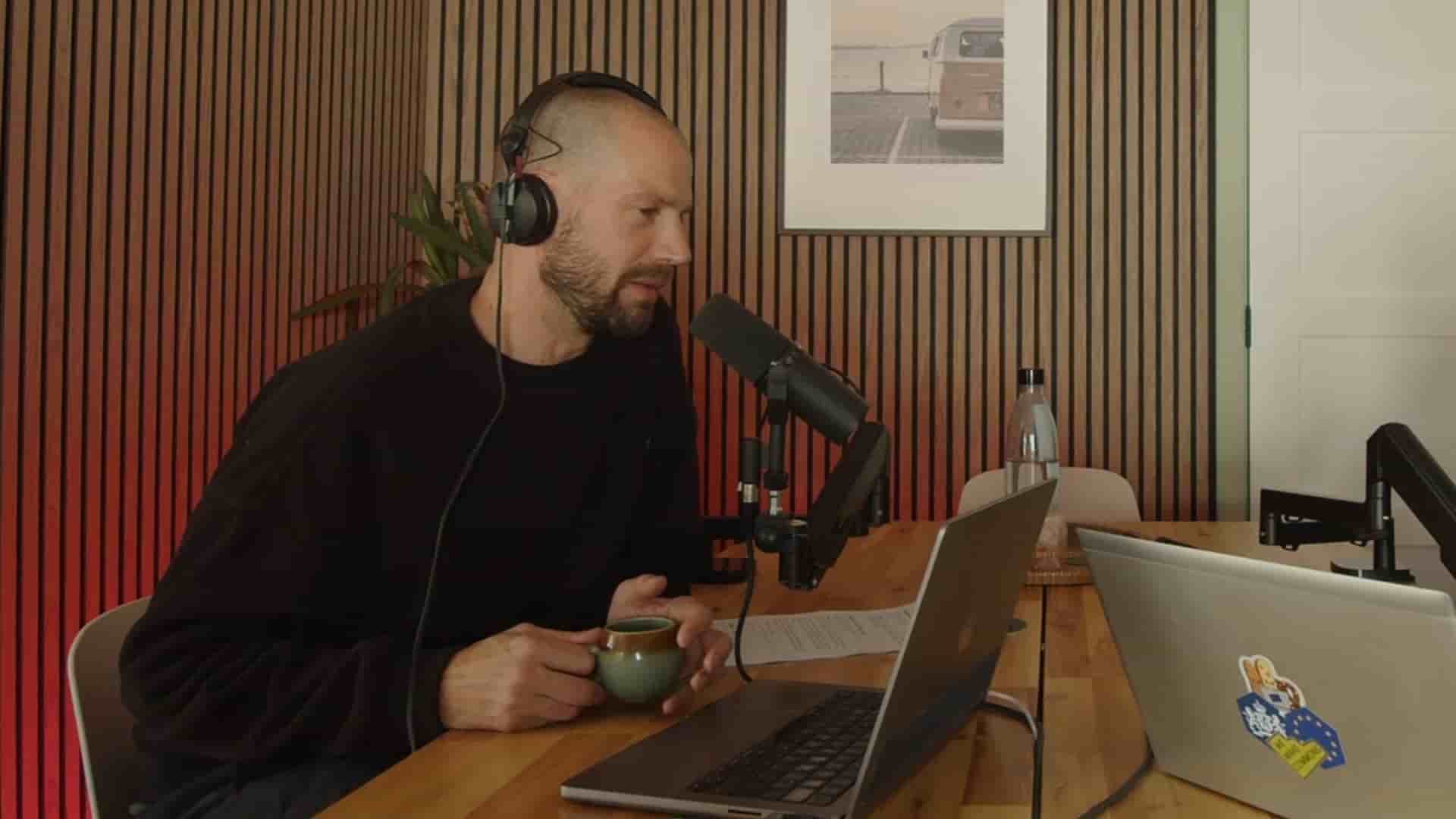
Two tech-minded friends launch a podcast by diving straight into AI security risks, humanoid robots replacing tradespeople, and the Dutch political battle over digital sovereignty.
An AI model that finds 211 security vulnerabilities in Firefox in a single night. Vulnerabilities that had gone undetected until then. That is the kind of development that keeps people staring at the ceiling at 3am, and it is a good starting point for asking whether we are actually equipped to handle what is coming.
Frank and Jakko are two friends who finally stopped talking about starting a podcast and actually did it. Frank works in the public sector, focused on what he calls socially responsible digitalization, and spends a lot of time thinking about technology, policy, and society at their intersection. Jakko is, by his own description, a terrible nerd who works at a tech startup building a podcast app, tinkers at night after the kids are in bed, and asks a lot of questions. Together they make a decent pairing: one with institutional perspective, one with hands-on technical obsession. The combination produces the kind of conversation worth having.
Anthropic's model Claude, specifically the variant known internally as Project Glass Wing, was used to find those 211 Firefox vulnerabilities. What is striking is not just the capability itself, but what Anthropic chose to do with it. They decided not to release the model publicly. The power was considered too significant to hand out freely.
And then it turned out a small group of users could access it anyway through a Discord server. No hack required. Just knowing where to look.
The real disruption isn't technical.
The question this raises is not really about the model. It is about the humans holding it. As Jakko put it, are we as a humanity wise enough to handle this kind of intelligence? His honest answer: probably not all of us, and most of us are not adequately equipped. The analogy that surfaces is an uncomfortable one: giving an atomic weapon to someone who has no real understanding of what they are holding.
Jesse Brouns, a former member of the Dutch parliament (Tweede Kamer) and ex-AIVD intelligence service employee, joined the conversation to add a sharper lens. His take is that it is not implausible that AI systems will eventually outperform nation-state actors in terms of hacking capability. Whether Claude already does that is unknowable from the outside. But the pattern-recognition component, identifying what deviates from what source code should look like, is exactly what AI is structurally good at.
What concerns him more is the power distribution question. Anthropic is not releasing Claude broadly. It is sharing access selectively, mostly with large American companies. That creates an asymmetry: the organizations that already dominate cybersecurity are now gaining access to the most advanced offensive and defensive tooling. For Dutch players and for European digital sovereignty more broadly, that asymmetry is a real problem.
"There will be a very different game if this becomes a scalable, advanced capability. It could easily result in a few companies gaining an enormous head start in the IT security market, making it harder for Dutch players to offer the same level of security." — Jesse Brouns
The attack-versus-defense dynamic is genuinely unsettled. On the defense side, AI models could be used for purple teaming: combining red team (attack simulation) and blue team (defense) approaches simultaneously, helping organizations find and patch their own vulnerabilities before adversaries do. On the attack side, threat actors can probe for vulnerabilities across massive surfaces at the same time, and not every organization has the capability to patch fast enough to keep up. The Dutch government's own track record on patching response times is, by Jesse's assessment, not encouraging.
Meanwhile, in Shenzhen, there was a major robotics trade fair. Frank came across footage and found it genuinely unsettling, though he stops short of making strong predictions. What caught his attention was less the spectacle of the fair and more a conversation happening in his own household.
His older son recently had to make a career choice. He had been doing an internship at a media-oriented company, and the people there, the people doing the job he was training for, told him directly: your job will not exist in ten years. Don't do this. So the son changed course entirely and enrolled in carpentry and interior construction training. Frank's reaction was: good call, learn a trade, work with your hands. And then he watched the Shenzhen footage.
A robot that lays bricks faster every day raises the question of whether any manual trade is truly safe from automation over a 15-year horizon.
Jakko had a direct reference point. His startup shares office space with Terraform, a company building bricklaying robots. He watched their robot every day as he came into the office, and every day it was measurably faster and more precise than the day before. Upload a house design, and the robot builds it, potentially with a single human operator standing by. That was already the reality one to two years ago.
The model Terraform's founder landed on: don't sell robots, sell the service. Large construction companies sign contracts. The robot shows up and lays the bricks. The parallel to Tesla's humanoid robot strategy is obvious, Jakko notes. You rent the capability. Maybe you pay for software upgrades.
The honest conclusion: a digital contractor who dispatches humanoid robots to build your house is not a thought experiment for 2050. It is a direction that current technology curves are pointing toward within a decade or fifteen years. Whether Frank's son made the right call is a genuinely open question.
Jesse's current read on the Dutch political landscape points to a rare moment of cross-party consensus. A motion by MP Kathmann passed with 141 votes in favor, calling on the government to not renew contracts with foreign cloud providers for critical public infrastructure, partly in response to the potential acquisition of one such provider. Digitalization is one of the few policy areas, Jesse notes, where you see unanimous votes across left, right, and center. That is unusual in Dutch politics, and it matters.
Whether the government will follow through is a separate question. Jesse's expectation is that it will, or the cabinet will need an unusually strong counter-argument. A short legal proceeding the following day adds another variable.
The broader principle at stake is strategic autonomy. Jesse is clear that the Netherlands cannot and should not try to compete with China or Russia on raw compute and energy for AI infrastructure. Those countries operate at a different scale. What the Netherlands can do is be deliberate about which dependencies it accepts and which it refuses. That means building sovereign AI safety capacity, maintaining independent relationships with security vendors who use models like Claude, and not letting the government's threat intelligence arrive exclusively through an American AI company's filter.
The shift from talking about digital autonomy to actually implementing it is what Jesse is now working on at Digitale Deling, after leaving parliament. In his words, there have been enough reports and talking clubs. The gap to close is the one between "we need to do something about this" and actually doing it.
Frank and Jakko are not trying to be the authoritative voice on any of this. Their framing is simpler: they find these things genuinely interesting, they know interesting people, and they want to have the conversations on the record. Technology and science at the intersection of society and the human experience. Quantum technology, solar engineering, AI policy, the future of work. Topics where someone who knows a lot about one thing can explain it clearly to people who know a little about many things.
The questions they are sitting with are the right ones. Who controls the most powerful AI models, and what does that do to the balance of power in cybersecurity? What do we tell the next generation about which skills are worth developing? Can Dutch and European institutions move fast enough to matter? None of these have clean answers yet. But they are worth asking out loud, and apparently worth losing sleep over.