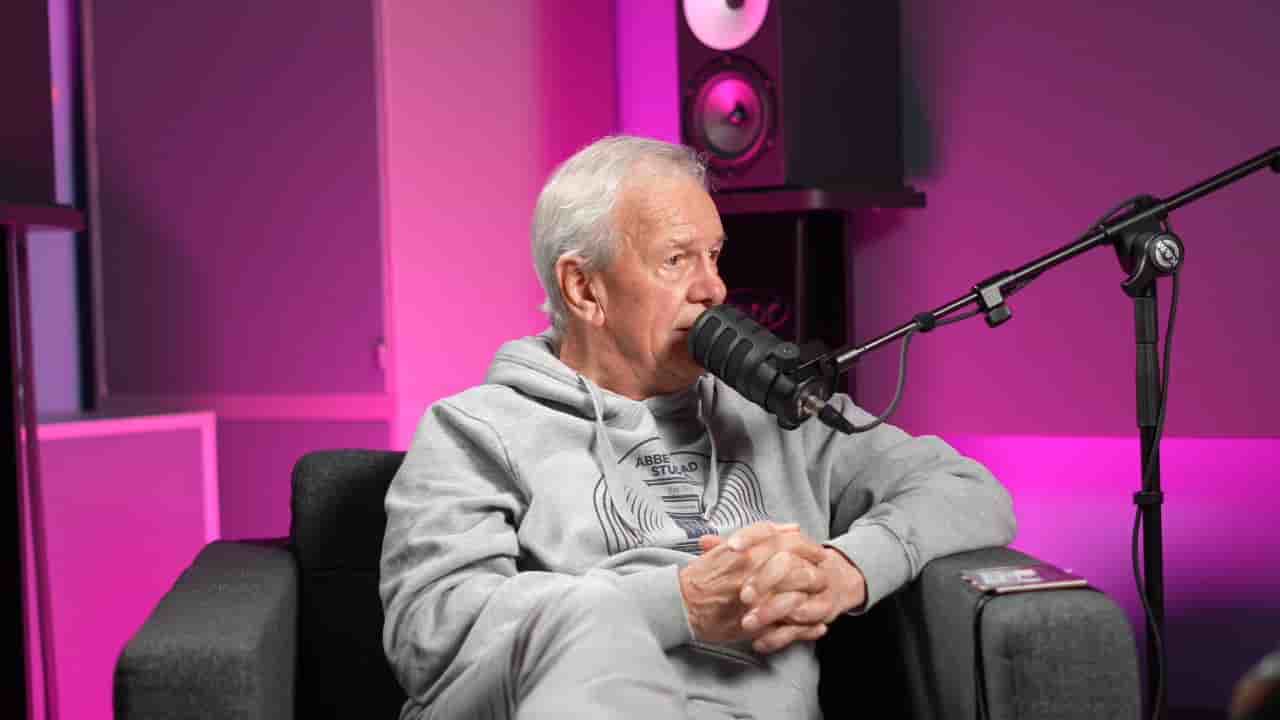
Fritz Egner and Alex Gernand swap stories from 50 years in music, from AFN Munich to Bravo, James Brown at the Apollo, and the backstage passes that started it all.
Between them, Fritz Egner and Alex Gernand have logged more than ninety years inside the music business. Fritz came in through a radio station — literally, by helping carry a billiard table through a doorway at AFN Munich in 1974 and somehow turning a crushed finger into a job offer. Alex came in through a fanzine he hand-painted with a mechanical typewriter borrowed from his grandmother, selling copies all the way to America via a classified ad in Kerrang! magazine. The medium was different. The obsession was identical.
Their new podcast, Egner und Gernand Backstage, is the product of two careers that kept crossing without quite connecting: both interviewed Robert Plant in the same hotel room in 1990 without knowing the other was there. Both turned up at the Tina Turner album release party in Cologne in 1989. They finally sat down properly only after the Jackson family's sole 2024 European concert, at Munich's Circus Krone, where Alex was moderating the press conference and Fritz was in the audience with his son. The conversation that followed made it obvious they had too many stories to keep to themselves.
Alex grew up in Lampertheim, a town of 35,000 near Mannheim. There was an ice cream parlour, a football pitch, and not much else. In 1983, at seventeen, he and a friend named Frank Meinl founded a heavy metal fanzine called Schockpower: hand-painted headers, articles typed on his grandmother's mechanical typewriter, photocopied and mailed to readers in the United States.
Boredom can make you creative — if you're bored and there's no phone, you build something.
The first issue to feature Metallica called Kill 'Em All the metal album of the year. That instinct held. What started as a way to put his own name under an article eventually became the calling card that got him hired at Bravo, Germany's biggest youth magazine. When he finally sat down with Bravo's editor-in-chief Rüdiger Wittner, he nearly didn't mention Schockpower at all — sure the editor would laugh at a black-and-white photocopied fanzine. He mentioned it anyway, almost as an aside. The editor leaned forward. A teenager who launched a publication, distributed it internationally, and sold subscriptions on the strength of a single classified ad? That was the story. Alex started at Bravo on April 15, 1988.
Fritz's entry point was equally accidental and equally revealing of character. He was an electrical engineering student who had already been nailing acoustic panels to the walls of Giorgio Moroder's first Musicland Studio in Munich's Arabella Park when he wandered into AFN at Karlbachstrasse 15 in Schwabing. He had no real plan to apply for a job — he just wanted to see the studios and meet the DJs he listened to every day. He ended up helping move a billiard table, pinched his finger badly enough to need attention from the station secretary, and then, when asked why he was actually there, told them he wanted to work as a studio technician. They said they were looking for an American. He said his English was pretty good. He got the job.
AFN was not German public radio. There were no hard separations between music, commentary, and personality. The DJ was part of the show — the voice and the taste and the enthusiasm were inseparable from the playlist. Fritz watched the American professionals work and absorbed a principle he carried for the rest of his career: every record you play should feel like it comes from genuine conviction, delivered only for the person listening.
Every record I play comes from my belief, my passion — and that's why I'm playing it.
That philosophy, transplanted into Bavarian German, was what his friends Jürgen Herrmann and Thomas Gottschalk heard when they listened to him at AFN and suggested he try a demo at Bayern 3. He brought his own jingles to the audition — Bavarian public radio had none at the time, because the concept came from American commercial broadcasting, where stations needed to identify themselves every thirty minutes to keep advertisers oriented. The demo landed him a slot. He stayed at Bayern 3 for forty-five years.
Fritz's conversion to Black music happened in a single evening. It was 1968 or 1969, and he was seventeen, in New York with an older female friend who had relatives on Long Island. He had worked through the tourist itinerary when he discovered there was one ticket left for a show in Harlem. He didn't know much about the Apollo Theater. He bought the ticket.
As the subway moved uptown, the faces around him changed. By the time he stepped out at 125th Street, he was the only white person on the block. Inside the Apollo, he was the only white person in the room. Then James Brown walked out with forty musicians, go-go dancers, and a master of ceremonies who introduced him as though he could walk on water. The show ran three or four hours without a break.
James Brown, forty musicians on stage, go-go girls dancing — a rhythm machine that just kept running.
Standing there, Fritz had one thought: he wanted to shake that man's hand and ask him where all that energy came from. He interviewed James Brown more than ten times over the following decades. At one session in London, he opened with his standard sign-off — "Mr. Brown, thank you for sharing your time" — and Brown told him: "You can call me James." Brown's own saxophonist pulled Fritz aside afterward and asked what he had done. The band still had to call him Mr. Brown.
Alex's entry into live music was less mythological but just as precise in his memory. October 6, 1980. Kiss headlining, Iron Maiden supporting, Karlsruhe. He was fourteen. His mother drove him from Mannheim. He still has the ticket. The tour was sponsored by Bravo, and the album cycle was Unmasked — which every fan assumed meant the band was about to reveal their faces. They didn't. That came three years later.
Fritz's first concert was harder to pin down exactly: either the Beatles or the Rolling Stones, both on Bravo-sponsored German tours in 1965 and 1966, both at the Circus Krone in Munich. He remembers recognizing "Long Tall Sally" from the Little Richard original he'd heard on AFN, and finding Little Richard's version better. He remembers the screaming drowning out the music, and Ringo Starr telling him years later that he sometimes couldn't hold the tempo because he couldn't hear what the others were playing. Charlie Watts reportedly felt the same way about the Stones tours. The PA systems of the mid-1960s were simply not built for what was being asked of them.
Both men describe their professional role the same way: they were intermediaries. They had access that fans didn't have, and their job was to carry something back.
"We are in a privileged position — we get time from these people for an interview, and we pass it on to the fans, to the readers, to the listeners." — Alex Gernand
The list Alex rattles off as examples is not designed to impress — it's the actual texture of twenty-five years at Bravo: Michael Jackson, James Brown, Tina Turner, Metallica, Fleetwood Mac, Rod Stewart, Joe Cocker, Phil Collins, Bruno Mars, Justin Bieber. Fritz's list runs through the AFN years and into Bayern 3: Bob Marley, Little Richard, three Beatles (George, Ringo, and Paul), Robert Plant, and enough others to fill the archive he's now trying to turn into an interactive quiz.
The access came partly from reach — Bavaria 3 had a million and a half listeners, which was significant leverage in an era before streaming fragmented audiences. But Fritz is clear that the initial meetings only got you so far. What kept doors open was the quality of the conversation. Word spread in the music business that you could go to him and he wouldn't ask about sock colours. "What's your favourite colour?" he says, laughing. "I avoided that even at Bravo."
Alex has a theory about musical identity that holds up well under examination. When you're very young, you like everything indiscriminately. As a teenager, you narrow hard and fast: you pick a genre, you pick a tribe, you adopt the clothing and the hair and the band patches. He was a metalhead. Long hair, denim jacket, Motorhead while the girls in his town were listening to Police and Supertramp.
Then something happens as you get older. The hourglass inverts. The taste widens again. Jazz starts making sense. Soul and R&B open up. You find that without the blues there is no heavy metal, and without rock and roll there is no blues, and suddenly Led Zeppelin sounds like it belongs in the same conversation as Marvin Gaye — because it does.
Fritz traces a parallel line through Elvis, AFN, and American soul, arriving eventually at James Brown and the full sweep of Black American music. The common thread in both stories is that someone older pointed the way: Alex had a neighbour named Oliver who played him Led Zeppelin, Black Sabbath, and Rainbow; Fritz had AFN, which transmitted American Top 40 across Europe on a signal strong enough, he learned from Paul McCartney and George Harrison, to reach Liverpool on medium wave on clear nights. McCartney told Fritz that the first time he heard rock and roll was over AFN Munich. Harrison said the same. Fritz draws the line carefully — he can't fully verify it as history — but the implication hangs in the air: the station where he got his start may have been part of what inspired the Beatles.
The podcast they're launching isn't a nostalgia project, or at least that's not how either man frames it. The first proper episode will focus on Michael Jackson, using the Michael biopic film as the entry point — a film critics savaged and audiences worldwide turned into one of the most successful music biopics ever made, surpassing Bohemian Rhapsody. Alex, who has interviewed Jackson's inner circle extensively and written a book on the subject, will bring specificity. Fritz will bring perspective. That division of labour suits them.
Alex kept the first issue of Schockpower from 1983. Fritz keeps his AFN jingles. The backstage passes they spread across the table during their conversation span five decades and four continents: James Brown at the Brixton Academy, Michael Jackson on the Dangerous and History tours, Madonna's Drowned World tour, Roxette at the Great Wall of China. Each one is a physical receipt for a moment where the distance between fan and artist briefly collapsed.
That collapse, Fritz says, was always the point. Not the credential, not the byline, not the broadcast reach. The point was the question you finally got to ask, and whether the answer told you something true about where the music came from. After fifty years of asking, they seem to have collected enough answers to keep talking for a while.